
Why Does Your Building Have No Cell Signal? A 3-Cause Diagnostic Framework
Use outdoor RSRP, building materials and coverage symptoms to separate a shielding problem from a weak network before you buy a signal booster.
On this page
If a whole floor has lost mobile coverage, the first instinct is usually to blame the operator. Sometimes that is correct. Often it is not. A building can sit in a strong outdoor field and still behave like a Faraday cage inside, and a site can have a perfect concrete structure with no usable network to amplify. Both situations look identical to a user holding a phone, but they require completely different answers.
This guide gives you a three-cause diagnostic framework. It is the same sequence we use when a buyer sends photos, a floor plan and a few signal readings: establish the outdoor reference, subtract the building loss, and only then decide whether a signal booster is the right tool.
Why does a building lose mobile signal even when the network is working?
Mobile signal is a radio path, not a utility connection. The level at your phone is the result of three things: the power radiated by the nearest base station, the distance and obstacles between that station and your building, and the materials between the outside face of the building and the point where you are standing.
A useful planning identity is:
Indoor level ≈ outdoor level − building penetration loss + booster gain
The first two terms are outside your control. The operator decides where towers are built and how they are aimed. The building decides how much energy reaches the interior. Only the booster gain is something you can add, and it is limited by output power, antenna gain, isolation and the number of service antennas.
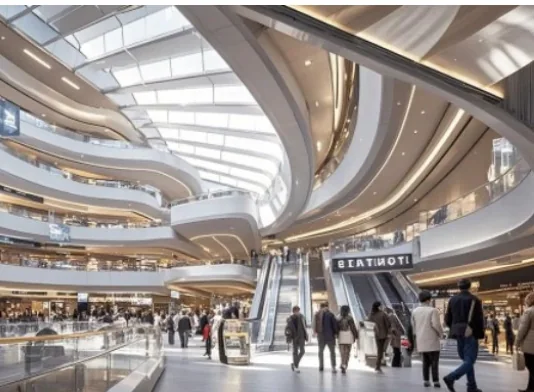
This is why “the network is working” and “the building has no signal” are not contradictory. The network may be perfectly healthy at the street, while the wall, roof, window coating and internal partitions remove 25-40 dB before the signal reaches the office. A phone that shows four bars at the entrance and one bar at the back of the floor is describing exactly that gradient.
What are the three causes of an indoor dead zone?
Almost every project falls into one of three categories. The category determines whether a booster is useful, what type of system is needed, and how honest the quotation should be.
| Cause | What you measure outside | What it means | Typical answer |
|---|---|---|---|
| A. Building shielding | Good outdoor signal, roughly -65 to -90 dBm | The building is blocking a usable network | Booster plus indoor distribution antennas |
| B. Weak outdoor network | Moderate to weak signal, roughly -95 to -110 dBm | The network reaches the site, but not strongly enough for normal indoor use | High-gain donor antenna, mast height, low-loss feeder; booster only after the donor link is improved |
| C. No usable coverage | No stable signal at any outdoor position | There is nothing to amplify | Different technology: VoIP, satellite, private LTE or an operator build-out request |
Cause A is the classic commercial coverage project. It includes metal-clad warehouses, concrete office cores, basements, cinemas, hotels with coated glass and multi-tenant buildings where tenants complain that calls drop when they walk away from the window.
Cause B is common in dispersed residential areas, industrial camps, farms, border posts and rural clinics. The building may not be especially well shielded, but the nearest tower is far away and the outdoor level is already marginal. Adding a larger indoor amplifier without fixing the donor side usually produces noise, alarms or self-oscillation rather than usable coverage.
Cause C is the case that a responsible supplier should refuse to solve with a repeater. No amount of gain creates a signal that is not there. The correct response is to document the finding and propose an alternative path.
How do you tell whether the problem is the building or the network?
Measure the same network in two places: outside the building, at the position where a donor antenna could realistically be installed, and inside the worst affected room. Use the same phone, the same band and the same operator if possible. Record the values in dBm rather than bars.
A simple diagnostic table looks like this:
| Outdoor level (RSRP) | Indoor level (RSRP) | What it suggests |
|---|---|---|
| -70 dBm | -100 dBm | Strong outdoor field with about 30 dB of building loss; a booster is likely to work |
| -85 dBm | -108 dBm | Usable outdoor field, heavy internal loss; check the donor position and antenna count |
| -100 dBm | -115 dBm or lower | Weak outdoor field; improve the donor antenna and height before selecting a host |
| No stable reading | No stable reading | Cause C; a repeater is not the right solution |
The difference between the outdoor and indoor readings is the building penetration loss plus the effect of internal walls. It is not a laboratory number, but it is the most useful number you can collect before a design conversation. If the outdoor reading is strong and the indoor reading is poor, the building is the problem. If both are poor, the network is the problem.
One warning: phone bars are not linear. A display that shows two bars may represent a level that is still usable for voice, while a different phone on the same network may show four bars at the same spot. Use the engineering screen or a measurement app that reports RSRP, SINR and the band. The measurement guide explains the readings in more detail.
Which outdoor signal level means a booster can help?
There is no universal threshold, because booster input range, band, antenna gain and local noise floor all matter. As a planning guide for commercial systems:
- Better than -85 dBm: a well-installed booster has a good chance of delivering usable indoor coverage, provided the antennas are separated and the building loss is not extreme.
- -85 to -95 dBm: the system can work, but the donor antenna, cable loss and mounting height become critical. Expect a more careful design and a larger antenna.
- -95 to -110 dBm: treat this as a donor-link project first. A high-gain directional antenna, a mast or roof position and low-loss feeder may recover enough signal. A standard indoor kit is unlikely to be enough.
- Below -110 dBm or unstable: the site is usually outside the practical range of a passive repeater. Confirm with a site test before promising coverage.
These values are planning references, not guarantees. The only reliable statement is the one supported by a before-and-after measurement at the site. That is also why a supplier who quotes a complete system without asking for an outdoor reading should be treated with caution.
What should you measure before requesting a quote?
Collect six pieces of information. They cost almost nothing and remove most of the uncertainty from the first quotation.
- Outdoor RSRP or received level at the proposed donor position, on each operator and band that matters.
- Indoor RSRP at two or three worst-case points, not only at the reception desk.
- Band and cell ID so the supplier can confirm that the booster covers the network you actually use.
- SINR or signal quality where available; a strong but noisy signal behaves differently from a clean one.
- Building details: number of floors, floor area, ceiling height, main wall and roof materials, and whether the windows are coated.
- Photos and a simple plan showing the building exterior, the proposed donor position, the cable route and the rooms that need coverage.
If you cannot access the engineering screen, write down the phone model and the displayed level in dBm from a measurement app. A supplier can work with an approximate reading as long as it is labeled as approximate. What they cannot work with is “the signal is bad” with no number.
For a multi-floor building or a warehouse, add a walk test: walk the main aisles, corridors and workstations, and mark on the plan where calls drop or data stalls. This turns a vague complaint into a coverage map that can be designed against. The warehouse guide shows how to structure that walk for a large industrial site.
When is a booster not the right solution?
A booster is the wrong answer in three situations.
There is no usable outdoor signal. If the roof and all exterior faces are below the system threshold, a repeater will amplify noise. The practical alternatives are a VoIP service over an existing broadband link, satellite backhaul, a private LTE network for a defined site, or a request to the operator for a new site. A good supplier should say this clearly instead of selling a kit that cannot work.
The problem is capacity, not coverage. A stadium, a packed conference hall or a warehouse with hundreds of simultaneous users may show adequate signal but still fail because the sector is congested. A coverage repeater does not add network capacity. Capacity problems need operator coordination, additional sectors or a different architecture. Be suspicious of a proposal that promises to fix congestion with a higher-gain amplifier alone.
The isolation cannot be achieved. A booster needs enough separation between the donor antenna and the service antennas. On a small site with a metal roof and no cable route, the required separation may be impossible. In that case, a fiber repeater, a different antenna position or a distributed system with remote units may be the only workable design. The long-distance donor guide explains the trade-off between gain, isolation and cable loss.
What does a diagnosis look like in practice?
Consider a three-floor office building with a concrete core and coated windows. The outdoor reading at the roof edge is -78 dBm. The worst indoor reading is -112 dBm on the second floor, and the reception area reads -96 dBm. The building loss is therefore around 34 dB at the worst point, with a further 16 dB difference between the reception area and the back office.
That pattern points to Cause A: a usable outdoor field and a building that removes most of it. A reasonable starting design would use a donor antenna on the roof with a clear path to the serving sector, a host sized for the total number of service antennas, and ceiling or wall-mounted antennas distributed along the floor. The exact count depends on the floor plan, but the design logic is clear before any model number is chosen.
Now change one number: the outdoor reading is -103 dBm instead of -78 dBm. The same indoor target now requires 25 dB more donor signal before the booster can do useful work. A larger indoor host will not solve that. The project becomes a donor-antenna and mast-height project, and the quotation should say so. This is the difference between a diagnosis and a product list.
What is the next step?
Start with the outdoor reading. If it is usable, the next step is to confirm the building loss and the antenna layout. If it is weak, the next step is to improve the donor link before choosing a host. If it is absent, the correct next step is an alternative technology, not a repeater.
Send us the outdoor and indoor readings, the band, the building type and a simple floor plan. We will tell you which of the three causes your site matches, and whether a booster is part of the answer.
Frequently asked questions
Can a signal booster fix a building with no outdoor signal at all?
No. A booster amplifies an existing outdoor signal; it does not create one. If no usable signal can be measured on the roof or at an exterior wall, the site needs a different solution such as a VoIP service, satellite backhaul, a private LTE network or a operator-funded base station.
My phone shows two bars outside. Is that enough for a booster?
Bars are not a measurement. Two bars can mean -85 dBm in one location and -105 dBm in another. Record RSRP or the received level in dBm at the proposed donor position, then compare it with the booster's rated input range.
Why does the signal disappear only in some rooms?
Local materials and geometry matter. A concrete core, a metal plant room, Low-E glass, a basement slab or a long corridor can create a local shadow while the rest of the floor still has usable signal. This is usually a distribution problem, not a total lack of outdoor coverage.
How many dB does a typical building wall cost?
A single brick wall may cost 5-10 dB (a plasterboard partition usually 2-5 dB), a reinforced concrete wall 15-25 dB, and metal cladding or Low-E glass 20-30 dB. The exact loss depends on thickness, reinforcement, window area and frequency, so the number should be confirmed by measurement.
Do I need a site survey before ordering a system?
For a single room or a small basement, a remote check with outdoor and indoor readings may be enough. For multi-floor buildings, warehouses and projects with more than a few antennas, a floor plan, photos and a walk test are needed to size the host and distribution network.
What is the first number I should send to a supplier?
Send the outdoor RSRP at the proposed donor antenna position, together with the band and the serving cell ID. Without an outdoor reference, any equipment recommendation is only a guess.
Related products
See All Products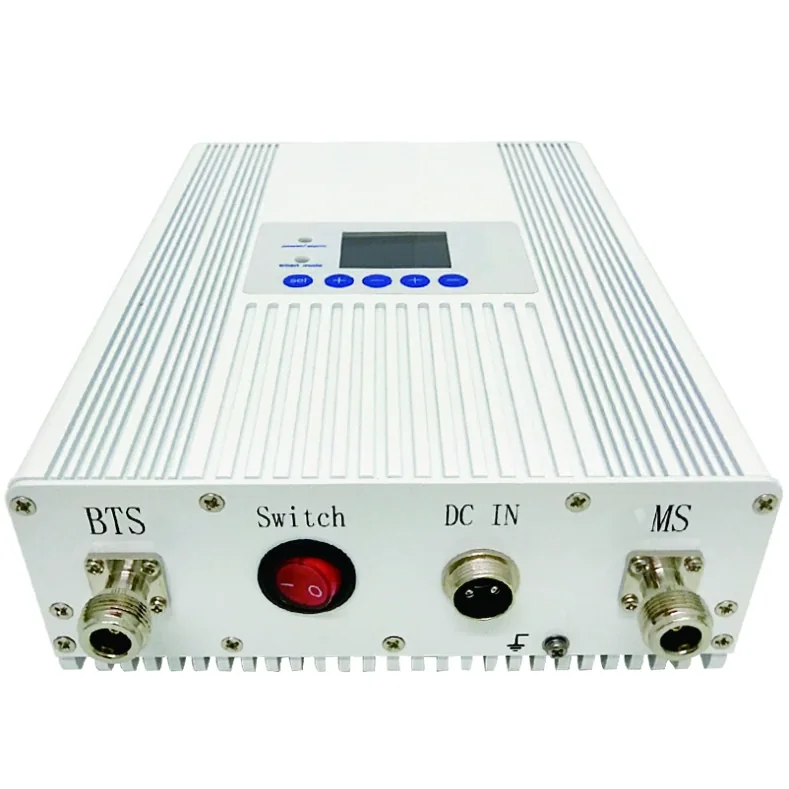
AL-30 Multi-Band LCD Signal Booster
Multi-band booster with LCD display, AGC and isolation detection for 100–3,000 m² coverage.
HAG-08-33 Dual-Band High-Power Booster
33–43 dBm dual-band booster covering up to 30,000 m².
HAG-D5-37 Long-Range Dual-Band Booster
37–43 dBm dual-band booster covering 3,000–15,000 m².
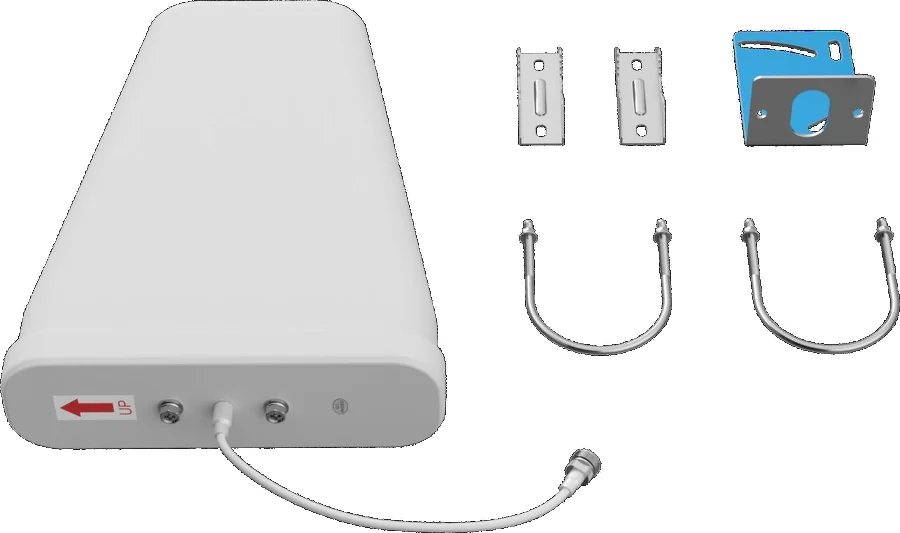
Wideband Log-Periodic Donor Antenna
10 dBi directional outdoor antenna for receiving donor signal.
View Details