
Which Building Materials Block Cell Signal? A dB Attenuation Guide
A practical guide to the dB loss of concrete, rebar, Low-E glass, metal cladding, brick and basement slabs, and what each material means for booster design.

On this page
A buyer rarely asks which material is blocking the signal. They ask why the phone worked before the renovation, why the new warehouse has no coverage, or why the whole floor lost signal after the facade was replaced. The answer is usually in the building envelope, and the useful way to discuss it is in decibels.
This guide gives planning ranges for the materials that matter most. The numbers are not a substitute for a site measurement. They are a way to understand why a building behaves the way it does, and to decide whether the next step is a bigger booster or a different antenna layout.
Which materials block cell signal the most?
The biggest losses come from materials that are electrically conductive or dense: reinforced concrete, metal cladding, metal roofing, foil-faced insulation, coated glass and earth-backed basement walls. Ordinary plasterboard and timber are comparatively transparent.
| Material | Typical additional loss | Where you see it | What it means for design |
|---|---|---|---|
| Reinforced concrete wall | 15-25 dB | Office cores, stairwells, car parks, basements | Plan for local service antennas, not one antenna for a whole floor |
| Concrete floor slab | 15-25 dB | Between floors, basement ceilings | Do not assume a signal will pass vertically through a slab |
| Metal cladding / metal roof | 20-30 dB | Warehouses, factories, cold stores, metal-sided buildings | The donor antenna must be outside the metal envelope |
| Low-E or coated glass | 20-30 dB | Modern office towers, hotels, airports | Window-facing rooms may work while internal rooms fail |
| Brick wall | 5-10 dB per wall | Older residential and commercial buildings | Several walls can still add up to a problem |
| Plasterboard / timber partition | 2-5 dB | Offices, hotels, residential interiors | Usually only matters when there are many partitions |
| Earth plus concrete (basement) | Often no usable path | Underground parking, plant rooms, tunnels | A donor antenna inside the basement usually cannot work |
The table is a planning aid. A thin concrete wall and a heavily reinforced shear wall are not the same, and loss changes with frequency. Higher frequencies generally suffer more, which is one reason a 2600 MHz band can behave differently from a 900 MHz band in the same building.
How much signal does concrete and rebar remove?
Reinforced concrete is the most common cause of a partial indoor dead zone. The concrete itself attenuates, and the steel reinforcement grid acts as a partial shield. A single 200-250 mm reinforced wall commonly adds 15-25 dB. Two such walls between the facade and the room can add 30-50 dB, and additional partitions can push the total higher.
This is why one indoor antenna at the end of a corridor often fails. The antenna may cover the corridor and the first row of offices, but the rooms behind two concrete walls receive very little. The signal level falls faster than the coverage map on a simple floor plan suggests.
Floor slabs deserve separate attention. A signal does not travel cleanly from a rooftop donor antenna to a basement through several concrete floors. In practice, each floor needs its own service antennas, and a basement needs a separate distribution branch. A design that relies on vertical penetration through a slab is a design that will produce complaints on the lower floors.
Why does Low-E glass behave like a Faraday cage?
Low-E glass is designed to reduce heat transfer. Many products achieve this with one or more thin metallic or metal-oxide layers. Those layers are also effective at reflecting radio waves. The result is a window that looks transparent but behaves like a partial Faraday cage at mobile frequencies.
The loss depends on the coating, the number of panes and the frequency. A range of 20-30 dB is a reasonable planning figure for a coated facade. Office workers often describe the effect precisely: calls work at the window, drop when they walk to an internal meeting room, and return when they return to the glass.
Window film and some tinted or reflective films can produce a similar effect after a retrofit. If the signal problem began after a facade upgrade, a window replacement or a film installation, the timing is a strong clue. Record it in the site notes.
What happens with metal cladding, roofing and insulation?
A metal building is close to a complete shield. Metal siding, a metal roof deck, metal sandwich panels and foil-faced insulation can add 20-30 dB, and the enclosure often has fewer openings than a masonry building. A warehouse can have strong outdoor coverage at the loading door and almost none in the middle of the racking.
The practical consequence is simple: the donor antenna must be mounted outside the metal envelope, with a cable route that does not pass through a long section of metal structure. Indoor service antennas then distribute the signal inside. Attempting to mount the donor antenna inside a metal warehouse usually produces a receiver reading that looks like a weak outdoor site even when the roof is only a few metres away.
Cold stores, clean rooms, data halls and industrial plant rooms can be worse because they combine metal panels with insulated or shielded construction. These projects need a material survey, not a generic kit.
How do you confirm that the material is the cause?
Measure the same operator and band at the outside face of the building and in the affected room. If the outdoor level is healthy and the indoor level is much lower, the building is the likely cause. Then walk the path between the two points and list what the signal passes through: external wall, window, internal wall, floor slab, metal door, plant room.
A simple record is enough:
| Observation | What it tells you |
|---|---|
| Strong at the facade, weak three metres inside | The facade or window coating is the main loss |
| Good in the corridor, poor behind two walls | Internal partitions and concrete core are the issue |
| Good on the top floor, poor in the basement | Vertical penetration is the problem; add a separate branch |
| Good at the loading door, poor in the aisles | Metal envelope and racking are the issue |
| Signal dropped after a renovation | New glass, film, cladding or insulation is the likely change |
The signal measurement guide explains which values to record. The key is to keep the operator, band and phone constant so that the difference reflects the building rather than a change in the network.
What can you do when the material cannot be changed?
You cannot remove the concrete core or replace the facade for a coverage project. The design response is to bring the signal around the obstacle rather than through it.
- Move the donor antenna outside the shield. For a metal warehouse, the donor belongs on the roof or an exterior wall, not inside the racking.
- Distribute service antennas where people work. More antennas at lower power are usually better than one high-power antenna behind a wall.
- Use a separate branch per floor or zone. A basement, a plant room and an office floor should not depend on one vertical path.
- Consider a fiber repeater for long or isolated runs. A fiber host and remote units avoid the cable loss of a long coaxial route through a large building.
- Use a window or exterior position for weak sites. Where the facade is the only usable signal path, a donor antenna at the window or on a small external mast can outperform a roof position behind a parapet.
A larger indoor amplifier is not a substitute for antenna placement. If the loss between the antenna and the user is 40 dB, adding 10 dB at the host recovers only part of it and may create isolation problems elsewhere.
Does frequency change how much signal is lost?
Yes, and the difference is large enough to change a design. Lower bands such as 700, 800 and 900 MHz diffract around obstacles and penetrate walls more effectively than 1800, 2100 and 2600 MHz. A wall that costs 12 dB at 900 MHz may cost 18-22 dB at 2600 MHz, and a coated window that is marginal on a low band may be effectively closed on a high band.
This has three practical consequences. First, record the band with every reading; an outdoor reading on 900 MHz cannot be compared with an indoor reading on 2600 MHz. Second, a site can have usable low-band voice coverage and almost no high-band data coverage, which is why calls work while video stalls. Third, a booster must cover the band the users actually need. A system that amplifies only a high band may look correct on paper and fail in the rooms where the low band was the only usable layer.
Material loss is therefore not a single number for the building. It is a number per path and per frequency. When a supplier asks for the band, this is why.
Which areas should you check first?
Start with the areas that combine high material loss with high business impact:
- Basements and underground parking — concrete plus earth, often no usable outdoor path.
- Stairwells and lift lobbies — concrete cores and metal doors.
- Internal meeting rooms behind coated glass — the window works, the room does not.
- Warehouse aisles and cold stores — metal envelope plus racking.
- Plant rooms and data halls — metal enclosures and shielded construction.
- Hotel rooms away from the facade — corridor walls and bathroom cores.
If the complaint is concentrated in these areas, the material story is consistent. If the whole building is equally bad, check the outdoor level first; the problem may be the network rather than the walls.
The next step is to put numbers on the path. Send the outdoor reading, the indoor reading and a short description of the materials between them. That is enough to decide whether the project needs a different donor position, more service antennas, or an honest conversation about an alternative technology.
Frequently asked questions
Does a single concrete wall really block mobile signal?
A single reinforced concrete wall typically adds 15-25 dB of loss. That is enough to turn a usable outdoor signal into a marginal indoor signal, especially when the outdoor level is already below -85 dBm.
Why did my signal drop after new windows were installed?
Low-E and other coated glazing contain thin metallic layers that reflect radio energy. The coating can add 20-30 dB of loss, which is why a room that worked before a facade upgrade can become a dead zone afterward.
Can a signal booster work through three concrete walls?
A booster can supply more energy, but every wall still removes part of it. Three reinforced walls may add 45-75 dB of loss. The practical answer is usually more service antennas in the affected rooms, not a larger amplifier at the other end of the corridor.
Does metal roofing block signal as much as metal wall cladding?
Both are effective shields. A metal roof deck, metal sandwich panel or metal siding can add roughly 20-30 dB, and the loss is often worse when seams, fixings and foil insulation complete the enclosure.
Are basement walls worse than above-ground walls?
Basements combine concrete walls, a concrete slab above and surrounding earth. The result is not just high loss but often no useful incident path at all, so the donor antenna has to be placed outside the basement rather than inside it.
How can I confirm that the material is the problem?
Compare the outdoor level at the facade with the indoor level in the affected room, then note the wall, window and roof materials in between. A large difference at the same frequency and on the same operator points to the building, not the network.
Related products
See All Products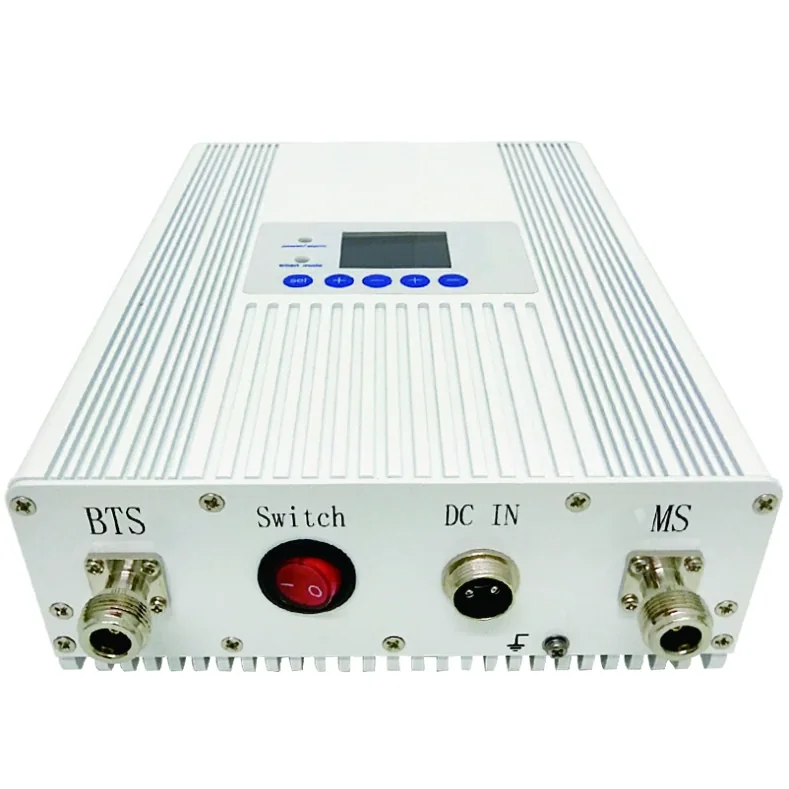
AL-30 Multi-Band LCD Signal Booster
Multi-band booster with LCD display, AGC and isolation detection for 100–3,000 m² coverage.
HAG-08-33 Dual-Band High-Power Booster
33–43 dBm dual-band booster covering up to 30,000 m².
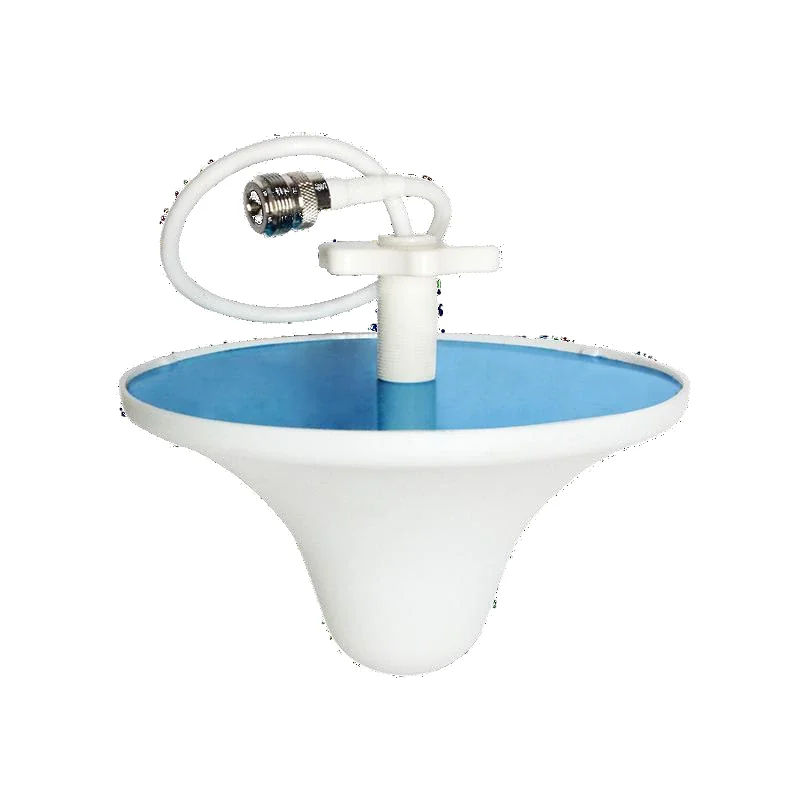
Indoor Omnidirectional Ceiling Antenna
3 dBi omnidirectional ceiling antenna for 800–2700 MHz.
View Details
Outdoor Directional Panel Antenna
7–9 dBi outdoor panel antenna for directional service coverage.
View Details