
5-Floor Office: Fixing Meeting-Room Dropouts Without Overloading the Network
A 2,400 m² office had usable signal at the windows but dropped calls in meeting rooms and the core. A three-band host with eight antennas balanced the floors.

How to read this case
Anonymized representative project profile. Figures are rounded planning values from a typical site, not a client testimonial or a performance guarantee.
Profile published October 2026
Country / city
Ghana / Accra
Building
Office, 5 floors
Covered area
2,400 m²
Envelope
Reinforced concrete, coated glazing
Operator
MTN Ghana, typical B3 / B7
Profile type
Deployed example
The constraint was the site, not the hardware
- Window-side RSRP was acceptable, but meeting rooms and the building core fell to −98 to −101 dBm.
- The client wanted stable voice and data for video calls without changing the interior design.
- The basement car park was much weaker at −110 dBm and could not be fixed by the same antenna layout.
- The system had to avoid excessive uplink noise and keep the operator network protected.
Representative meeting-room RSRP
Before
−101 dBm
After
−85 dBm
Measured at table height, away from the window
Representative test points: before and after
Representative test points with rounded values. Actual results vary with floor, walls, antenna position and operator load.
| Test point | Before RSRP | After RSRP | Before SINR | After SINR |
|---|---|---|---|---|
| Roof donor reference | −78 dBm | −78 dBm | 7 dB | 7 dB |
| Meeting room, floor 3 | −101 dBm | −85 dBm | 1 dB | 15 dB |
| Open office, floor 4 | −98 dBm | −83 dBm | 2 dB | 17 dB |
| Core corridor | −104 dBm | −89 dBm | 0 dB | 10 dB |
| Basement car parkCoverage improved but remained below the office-floor target | −110 dBm | −91 dBm | −2 dB | 6 dB |
What changed
- Office floors measured −83 to −89 dBm, with SINR of 10–17 dB.
- Video calls and voice calls were stable in the tested meeting rooms and open offices.
- The basement improved to about −91 dBm but remained a candidate for a dedicated antenna design.
Engineering takeaways
- Window-side measurements can hide core and meeting-room problems. Test where people actually work.
- A three-band host can cover the primary carriers, but the extra band should be confirmed before ordering.
- Do not stretch an indoor design to cover a basement car park. Separate loss, antenna layout and sometimes a separate host are required.
Configuration used in this profile
Related solution
Office Buildings
Hosts that can serve as a starting point
Final model and bands are confirmed against site measurements, operator and coverage target.
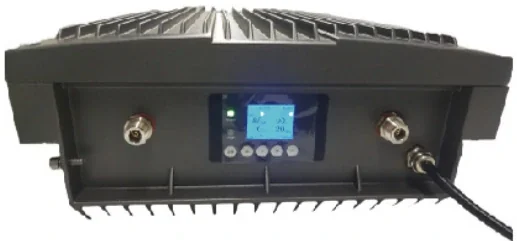
HAG-33DB3P Tri-Band Booster
Tri-band 33 dBm booster for multi-operator coverage.
HAG-30DB3P Tri-Band Booster
Tri-band 30 dBm booster for offices, shops and small commercial sites.
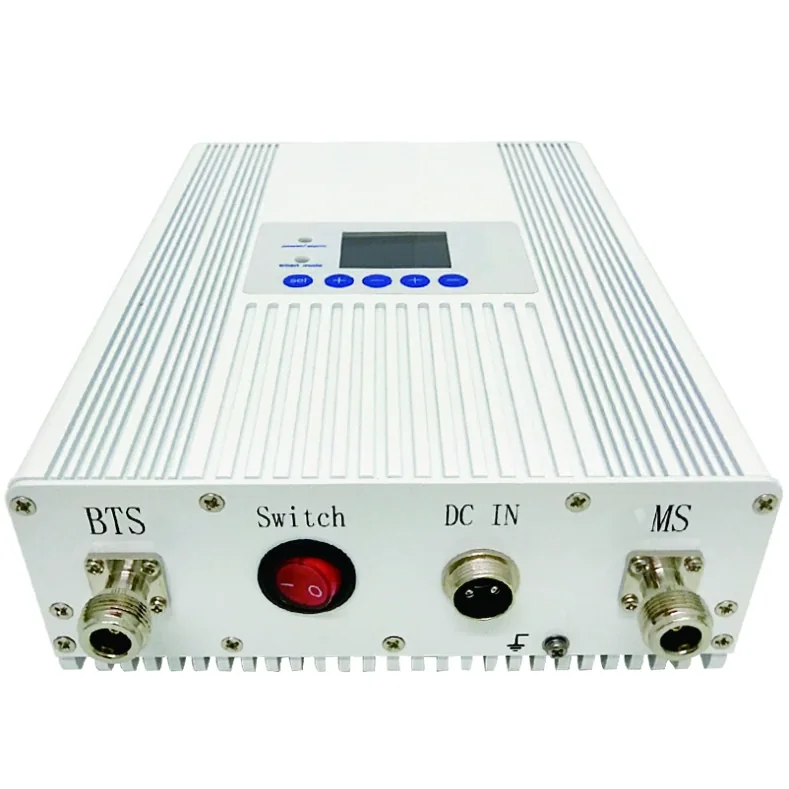
AL-30 Multi-Band LCD Signal Booster
Multi-band booster with LCD display, AGC and isolation detection for 100–3,000 m² coverage.
Will the system interfere with the mobile network?
A properly installed system with adequate isolation, ALC/AGC and compliant output power should not interfere. Installation must follow local regulations and operator requirements.
Can the basement be added later?
Yes, but it should be designed as a separate zone with its own antenna calculation. Adding basement antennas to the same host may reduce the gain available to the office floors.
How long does a typical office installation take?
A project of this size is typically a multi-day installation, depending on cable routes, ceiling access and building permissions. The exact schedule is confirmed after a site visit.
Send us your site data
Download the survey pack, record outdoor RSRP, indoor test points, building envelope and photos, then send it for a first review.